Washington Update, March 20, 2026

Dear Colleagues,
Spring is beginning to arrive in Washington, and with it, the familiar rhythm of the federal policy calendar. Congress may appear quiet at moments, particularly during recess weeks, but the real work of education policy rarely pauses. Much of the movement this month is happening beneath the surface: through agency restructuring, regulatory updates, and shifts in how programs are actually administered across federal departments. This update covers significant developments spanning appropriations, interagency agreements, student aid, special education data, and federal grants policy. There is a lot to track, and I want to make sure you have what you need.
For those planning advocacy visits in the coming weeks: it is nearly cherry blossom season in Washington, a welcome reminder that spring, and the heart of the policy calendar, have officially arrived.
1. CONGRESSIONAL ACTIVITY AND BUDGET SIGNALS
The House was out of session last week while House Republicans held their annual policy retreat. A central question under discussion: whether to pursue a budget reconciliation package, a procedural vehicle that would allow certain priorities to advance in the Senate with a simple majority rather than the typical 60-vote threshold.
Some House Republicans are pushing to use reconciliation to advance priorities like additional defense spending and other policy initiatives. The Administration and Senate Republicans, however, are urging the House to pass a single, comprehensive bill covering the full scope of their agenda. That tension remains unresolved and will shape the legislative calendar for months ahead.
Appropriations work for the current fiscal year also remains unfinished, and funding for the Department of Homeland Security has not yet been finalized. Looking ahead, the Administration is expected to release a “skinny budget” for FY 2027 during the week of March 30. These submissions provide topline discretionary spending totals by agency and offer a first signal of the Administration’s funding priorities before a full, detailed request follows later in the spring.
What to watch: The FY27 skinny budget, expected March 30, will give us our first real read on the Administration’s intentions for education funding. TED will analyze and share what it means for IDEA and educator preparation as soon as it is released.
2. ADMINISTRATIVE RESTRUCTURING: INTERAGENCY AGREEMENTS
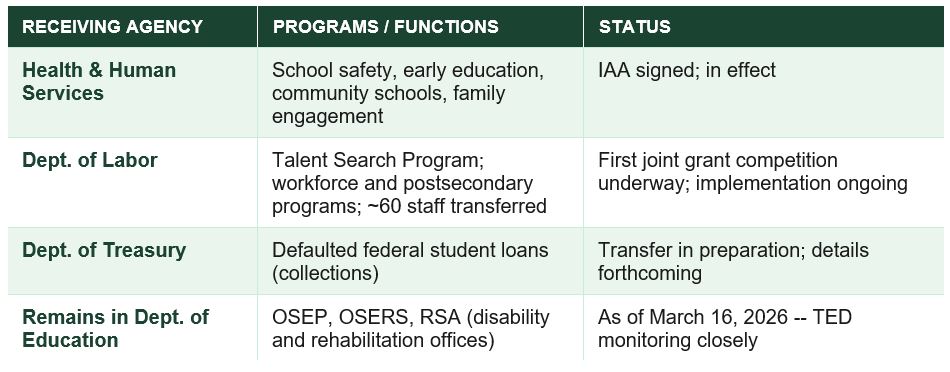
In recent weeks, the Administration has continued to expand its use of Interagency Agreements (IAAs) to shift core functions out of the Department of Education and into other federal agencies. Over the past year, portions of the Department’s portfolio have steadily migrated through this approach.
Most recently, two additional IAAs were announced, including one moving select school safety, early education, community schools, and family engagement programs to the Department of Health and Human Services. Notably, several key disability and rehabilitation offices, including OSEP, OSERS, and RSA, remain within the Department for now, even as broader structural changes continue to take shape. TED will continue to monitor and share updates as they emerge.
The IAA strategy is now beginning to show up in implementation. The Departments of Education and Labor launched a joint grant competition for the Talent Search Program, with awards administered through Labor’s system and staff already transitioning to support the shift. Administration officials point to increased efficiency and workforce alignment, though early implementation has not been without challenges.
This approach has also extended to federal student aid. The Department is preparing to transfer responsibility for defaulted student loans to the Treasury Department, targeting a portion of the portfolio and formalizing existing collection efforts. While details remain limited, the move is being framed as part of a broader push to streamline operations and reconfigure the federal role in education.
3. CONGRESSIONAL OVERSIGHT: SENATE HELP COMMITTEE
During a recent markup in the Senate Health, Education, Labor, and Pensions (HELP) Committee, lawmakers debated two education bills largely unrelated to special education, but the IAA question dominated the conversation.
Senator Tim Kaine (D-VA) introduced two amendments: one aimed at preventing the use of IAAs to functionally dismantle the Department of Education, and another specifically prohibiting the transfer of IDEA-related programs out of the Department. Both amendments were ruled nongermane and were not adopted, but the debate itself was significant. It put congressional concerns about administrative restructuring squarely on the record and reflected real bipartisan unease about the pace and scope of these changes.
Perhaps most notably, HELP Committee Chairman Bill Cassidy (R-LA) indicated that he has asked Education Secretary Linda McMahon and HHS Secretary Robert Kennedy Jr. to testify before the Committee regarding these arrangements. That request signals that congressional oversight of the IAA process is very much active, and that even members of the majority are watching carefully.
Why this matters for TED: The Kaine amendments and Chairman Cassidy’s oversight request reflect the kind of bipartisan concern that creates real space for advocacy. TED will keep members informed as hearing dates are confirmed.
4. STUDENT AID POLICY: WORKFORCE PELL AND THE PELL FISCAL OUTLOOK
The Department of Education recently released proposed regulations implementing the Workforce Pell Grant program, authorized in last year’s budget reconciliation legislation. The rule would allow Pell Grants to be used for short-term workforce training programs lasting as little as eight weeks, compared to the previous fifteen-week minimum. The program is expected to be administered through existing accreditation and state authorization frameworks, with additional details still being developed.
At the same time, the Pell Grant program faces growing fiscal pressure. The Congressional Budget Office estimates a $5.4 billion shortfall in FY 2026, potentially rising to $11.5 billion in future years. The shortfall reflects expanded eligibility following FAFSA simplification combined with relatively flat appropriations. Congress maintained the maximum Pell award at $7,395 for the upcoming academic year, but that figure provides little buffer against a structural funding gap of this scale.
For educator preparation programs, this is not an abstract fiscal concern. Many teacher candidates, especially those entering special education and other high-need fields, rely on Pell Grants as the foundation of their financial aid. A widening Pell shortfall has direct implications for who can afford to enter the profession.
5. IDEA DATA UPDATE: “OUR KIDS COUNT”
New analysis from the Advocacy Institute offers a compelling picture of just how many students depend on the special education system. Using the most recent data released by the U.S. Department of Education under IDEA Section 618 reporting requirements, the Institute’s “Our Kids Count” report finds that the number of children ages 3–21 receiving IDEA services increased by nearly 302,000 students in the most recent reporting period, bringing total enrollment to 8,194,424 students nationwide.
In contrast, Part C early intervention services saw a slight decline: children ages birth through two receiving services decreased by approximately one percent. That trend is worth watching. Early intervention plays a critical role in long-term outcomes, and in the downstream demand for school-age special education services.
In the absence of a 2025 congressional report from the Department, the Advocacy Institute compiled comparative charts and analysis showing changes across states, disability categories, student characteristics, and placement settings. The data reinforce what many in our field are already experiencing directly: continued growth in school-age special education enrollment is placing mounting pressure on educator pipelines and service delivery systems.
The numbers say it clearly: more than eight million students are counting on the special education workforce. This is the backdrop for every policy conversation happening in Washington right now.
6. FEDERAL RESEARCH INFRASTRUCTURE: PROPOSED REFORMS TO IES
The Department of Education recently released recommendations outlining potential reforms to the Institute of Education Sciences (IES), the federal government’s primary education research and data agency. The proposals focus on modernizing research infrastructure and strengthening the connection between research findings and practical application in classrooms and districts.
Proposed areas of reform include:
• Streamlining the organizational structure of IES
• Expanding modern data infrastructure and analytic capacity
• Strengthening partnerships with states and districts
• Improving translation of research findings into practical tools for educators and policymakers
Additional implementation details are expected later this year. TED will continue to track this process and engage where opportunities arise to elevate the field’s priorities.
7. FEDERAL GRANTS POLICY: PROPOSED DEI CERTIFICATION REQUIREMENT
The Administration has proposed a significant new government-wide policy affecting federal grants. The General Services Administration (GSA) is seeking public comment on a proposal that would require applicants for federal grants and contracts to certify that their programs do not include diversity, equity, or inclusion components or practices.
If implemented, the certification requirement could apply to more than 200,000 federal grantees and contractors, including universities and research institutions. Public comments on the proposal are due March 30, and the proposal has already prompted substantial discussion across higher education and research communities about its potential implications.
Public comments are due March 30. If your institution is considering submitting a response, TED is tracking this closely and can provide context on how the proposal intersects with educator preparation and special education program funding.
8. FY27 APPROPRIATIONS: IDEA PERSONNEL PREPARATION
Appropriations activity for FY27 is beginning to accelerate. Congresswoman Jahana Hayes is leading a House letter urging appropriators to provide $300 million for IDEA Part D Personnel Preparation, the federal government’s primary investment in preparing the workforce responsible for delivering services under the Individuals with Disabilities Education Act.
The case is strong: nearly every state reports shortages of special education teachers, and the number of students receiving IDEA services has increased by more than one million over the past decade. A companion letter is expected in the Senate, where Senator Tim Kaine plans to lead the effort to sustain and strengthen this investment.
If your institution or organization would like to sign on to either letter, now is the time to act. TED can help connect members with the appropriate congressional contacts.
Two important deadlines are also on the horizon for members engaged in direct appropriations advocacy:
House Labor-HHS-Education Subcommittee (deadline: March 27). The Subcommittee has extended its deadline for Representatives to submit funding and language requests by one week, to March 27. The extension covers both programmatic and language requests and earmark requests. Members should check with their congressional offices for guidance links.
Senate Labor-HHS-Education Subcommittee (deadline: April 16). The Senate Appropriations Committee has posted guidance for Senators to submit programmatic and Congressional Directed Spending (earmark) requests, with the Labor-HHS-Education Subcommittee deadline set for April 16. Notably, unlike the House Subcommittee, the Senate will allow Senators to submit up to 65 requests for the Labor-HHS-Education bill. That includes the two Education accounts that have hosted earmarks in recent years: the K-12 Fund for the Improvement of Education and the higher education Fund for the Improvement of Postsecondary Education.
If your institution works with a Senator on the Appropriations Committee or has a relationship with a member interested in submitting requests, April 16 is the window. TED can help members think through what requests to prioritize.
9. FIELD DATA COLLECTION: IMPACT OF GRANT CANCELLATIONS
Several national organizations are working together to document the impact of grant cancellations that affected educator preparation programs last year. The National Center for Teacher Residencies (NCTR), the American Association of Colleges for Teacher Education (AACTE), and Deans for Impact have launched a coordinated data collection effort to better understand the scope and consequences of those cancellations.
Responses will remain anonymous and reported in aggregate, unless respondents explicitly grant permission for their information to be shared. The resulting analysis will inform a forthcoming congressional briefing and report examining the effects on educator preparation programs and workforce pipelines.
If your program was affected and you have not yet responded to the survey, I encourage you to do so. Access the questionnaire here. Documenting what happened is an essential first step toward making the case for restoration.
If you have additional feedback on the impact of these cancellations, or if you would like to share information beyond what the survey captures, please feel free to reach out directly. This community’s experience needs to be part of the congressional record, and TED is committed to making sure it is heard.
On a personal note: it was a genuine privilege to spend time last week at the CEC Annual Convention. Being in town with so many educators, researchers, faculty, and advocates was a powerful reminder of why this work matters. The dedication across this community continues to shape both policy conversations and the future of special education in ways that are real and lasting. Thank you for the work you do every day.
Until next time,
Kait
Dr. Kaitlyn Brennan
Policy Advisor, TED | Teacher Education Division, CEC
@brennan_kait
